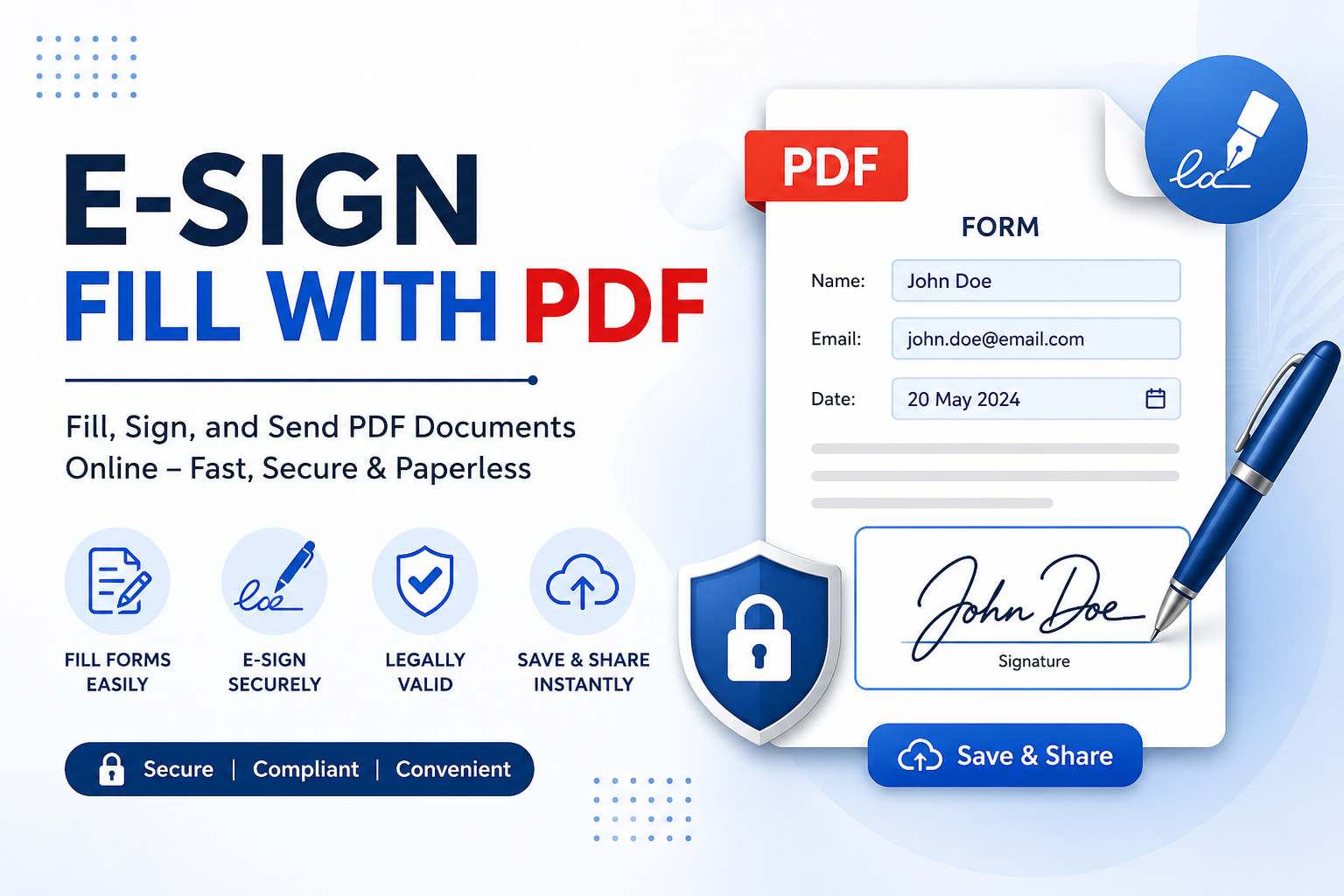
E-Sign PDF Documents: Fast, Secure, and Paperless Workflow
A procurement manager I spoke with last year thought the contract was finished. The vendor had approved it. Legal had reviewed it. Finance had signed off. Everyone assumed the deal would be completed before the weekend. Then someone printed the document. Three days disappeared.
One signature was missing. Another executive was traveling. A scanned copy arrived with poor image quality. The final PDF contained pages in the wrong order. What should have been a fifteen-minute approval process turned into nearly a week of emails, phone calls, and frustration. I've reviewed enough document workflows to notice a pattern. The delay rarely comes from decision-making. The delay comes from paperwork pretending to be digital.
Most organizations believe they're running digital operations because documents exist as PDFs. Reality tends to look different. A surprising number of business processes still depend on printing, signing, scanning, renaming files, attaching emails, and manually tracking approvals. That's where e-signatures changed the conversation. Not because they eliminated signatures. Because they eliminated waiting.
The Real Problem Was Never Paper
People often frame e-signatures as an environmental story. Less paper. Fewer printers. Reduced storage. That's true, but honestly, those benefits rarely convince executives to invest. Speed does.
A sales contract sitting in someone's inbox costs money. A vendor agreement waiting for a physical signature delays procurement. A government application stuck between departments slows entire projects.
What looks simple on paper often becomes expensive in practice
I've seen organizations spend thousands optimizing software systems while ignoring document approval chains that quietly waste hours every single day. Nobody notices the bottleneck until deadlines start slipping. Then the real problem appears.
PDFs Became the Universal Language of Business
The reason e-sign technology exploded around PDF documents isn't particularly glamorous. PDFs behave predictably. A document created on one computer usually looks identical on another. Legal departments trust that consistency. Compliance teams appreciate it. Auditors depend on it. The irony is hard to ignore. Many organizations spent years building sophisticated cloud platforms while still passing contracts around as email attachments. The format stayed old. The workflow evolved. And that distinction matters.
What vendors rarely mention is that businesses rarely purchase e-sign solutions because they're excited about digital signatures. They purchase them because managing document chaos becomes unbearable at scale.
One contract? Easy. Five thousand contracts every month? Different story.
Fast Doesn't Mean Simple
Marketing material loves the word "instant." I've never liked it. Nothing involving legal agreements, compliance requirements, identity verification, approval hierarchies, and audit trails is truly instant. The signature itself takes seconds. Everything surrounding it does not. The signature is only one small piece of a much larger trust framework. Most executives discover this too late. They expect a digital signature platform to behave like a digital pen. In reality, it's closer to a document governance system.
Security Is Usually Misunderstood
Whenever security enters the conversation, people immediately focus on encryption. Encryption matters. But operational behavior matters more. I've watched organizations implement highly secure signing platforms while employees continue forwarding sensitive PDFs through personal email accounts. The software wasn't the weak point. The people were. That's not criticism. It's operational reality. Security failures often begin long before someone signs a document.
Who can access the file?
Who can download it?
Who can forward it?
Who can replace it?
Who can claim they never received it?
Those questions create more risk than the signature itself.
Most users never notice this part. They click "Sign" and move on. Compliance teams don't have that luxury.
What Actually Happens Behind the Signature
Time stamps document events. Cryptographic processes help detect tampering after completion. Sounds straightforward. Until a dispute appears two years later. That's when audit trails become valuable. I've seen organizations recover from legal challenges because they could prove exactly when a document was viewed, signed, and finalized. I've also seen companies lose arguments because their records were incomplete. The difference wasn't technology. The difference was process discipline.
Why Remote Work Accelerated Everything
Many companies didn't adopt e-signatures because they wanted innovation. They adopted them because they had no choice. A surprising number of organizations discovered this during remote work transitions. Documents suddenly had to move between cities, states, and countries without physical interaction. Paper workflows started breaking almost immediately. Managers who previously insisted on physical signatures changed their position remarkably fast when employees were no longer sitting in the same building. Funny how that happens. Policies that appear non-negotiable often become flexible when operational pressure increases.
The Hidden Cost Nobody Calculates
Paper isn't expensive. Printers aren't expensive. Even storage isn't particularly expensive anymore. The hidden cost is attention. Every manual document process consumes human attention. An employee checks email.
Downloads a file
Prints it
Signs it
Scans it
Uploads it
Sends confirmation
Repeats the process. Individually, none of these steps seem significant. Collectively, they become organizational friction. Procurement teams run into the same problem repeatedly. Nobody notices small delays because they're distributed across hundreds of employees and thousands of transactions. Yet those tiny interruptions quietly consume enormous amounts of productive time.
PDF Integrity Matters More Than Ever
This becomes especially relevant as design standards evolve. A PDF must preserve exactly what was approved. Think of a PDF like a sealed shipping container. The contents matter, but so does evidence that nobody opened the container during transit. That's essentially what digital signing mechanisms attempt to achieve. If somebody modifies content after signing, verification systems should reveal that change.
Simple idea. Very difficult problem. That's why trust remains the entire foundation of electronic document workflows. Without trust, the speed advantage disappears instantly.
The Market Has Matured, But New Questions Are Emerging
The conversation used to focus on whether electronic signatures were legally acceptable. That debate is largely settled in many industries. Today's challenge looks different.
How do organizations manage identity?
How do they verify authenticity across borders?
How do they integrate signing workflows into increasingly automated business systems?
Conclusion
And perhaps the biggest question of all. As artificial intelligence begins generating documents, reviewing contracts, and automating approvals, how will organizations verify that the person approving a document is still making a meaningful decision rather than simply clicking through another automated workflow?
The technology solved the paper problem years ago
The trust problem is only getting started.