Global PDF Market Demand and Usage:
The Quiet Infrastructure Nobody Notices Until It Breaks
The argument wasn't about software. At least that's how it started. A procurement team at a large public-sector organization was debating storage budgets when someone pulled up a report showing that document volumes had nearly doubled in less than four years. The surprising part wasn't the growth itself. It was the file format behind most of it. PDF.
Nobody in the room was discussing artificial intelligence, cloud migration, digital transformation, or any of the fashionable terms that dominate conference stages. They were talking about invoices, contracts, tax forms, compliance records, engineering drawings, scanned certificates, legal notices, and application documents.
The mundane stuff.
I've reviewed enough digital workflow projects to notice a pattern. The technologies attracting headlines are rarely the technologies consuming most of the operational workload. PDFs sit quietly in the background while organizations obsess over newer tools.
Then the storage alarms start ringing.
The irony is hard to ignore.
Many businesses claim they're becoming paperless. Yet the volume of PDF documents being created, shared, archived, compressed, signed, reviewed, and uploaded continues climbing.
On paper, that sounds contradictory.
Reality tends to look different.
When organizations eliminate physical paper, they don't eliminate documents. They simply replace filing cabinets with digital repositories. The document itself survives. The format survives. In many industries, PDF remains the closest thing to a universal business language.
What vendors rarely mention is that standardization creates dependence.
A procurement officer in India, an insurance company in Germany, a law firm in the United States, and a logistics operator in Singapore may use completely different software stacks. Yet all four can exchange PDFs without worrying about formatting disasters.
Banks archive them.
Universities distribute them.
Healthcare systems store them.
The market expands because organizations continue generating records.
And records rarely disappear.
What's interesting is where growth is actually occurring.
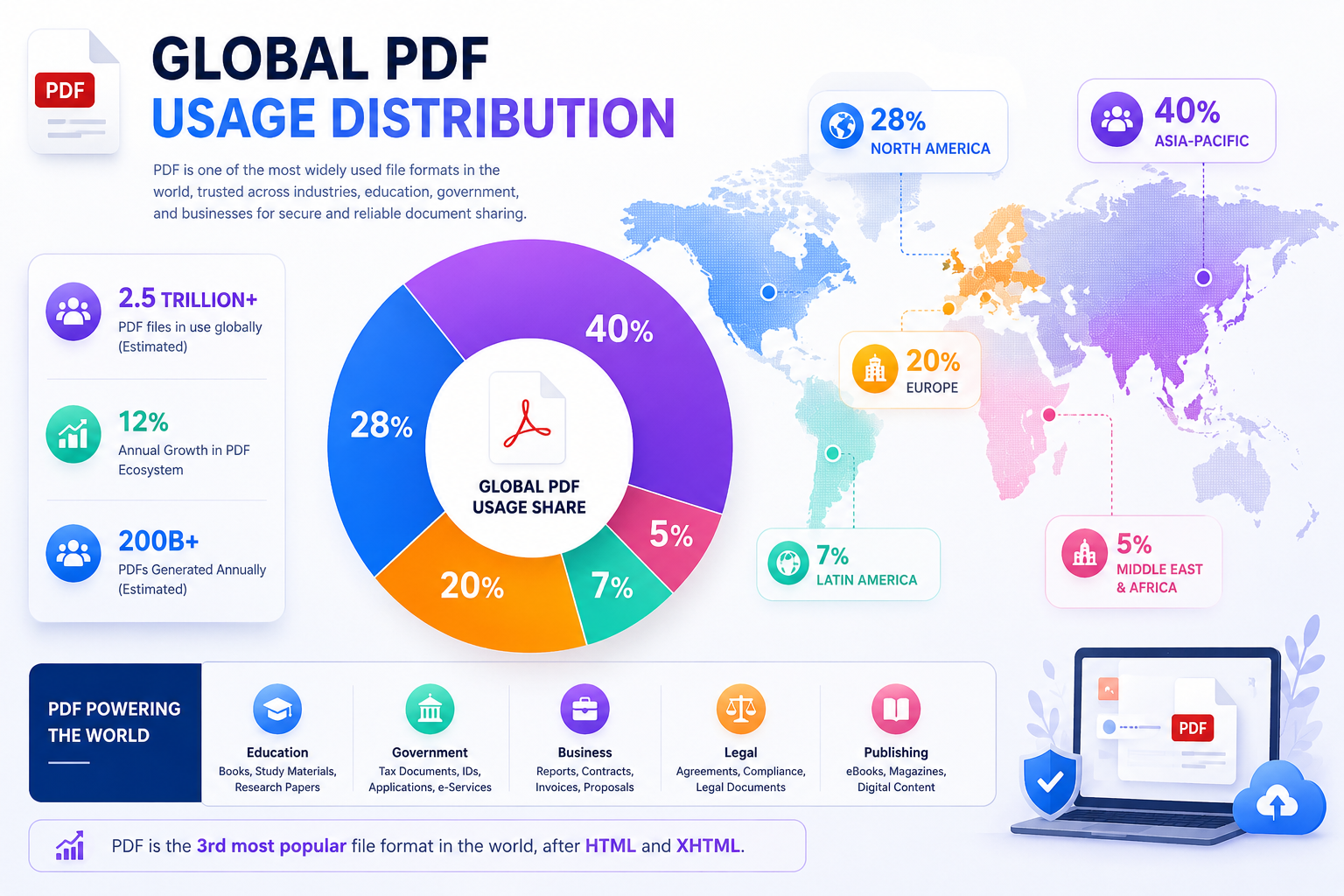
Many executives assume PDF demand is strongest in highly digitized economies. That's only partially true. Some of the fastest increases are happening in regions where government services, financial inclusion programs, educational digitization projects, and online application systems are expanding simultaneously.
A citizen applying for a passport uploads PDFs.
A student submits PDFs.
A small business files documentation as PDFs.
A contractor submits tenders as PDFs.
Different users. Same format.
The file becomes a bridge connecting organizations that may never share technology standards.
That's where the story changes.
Most market forecasts focus on software revenues. They discuss PDF editors, converters, compressors, and e-signature platforms.
The real growth engine isn't editing.
It's documentation.
Every new regulation creates paperwork.
Every compliance framework creates documentation requirements.
Every digital service introduces submission processes.
Every audit trail demands records.
Organizations don't purchase PDF tools because they love PDFs. They purchase them because operational systems require document outputs.
Most executives discover this too late.
A company launches a customer portal expecting smooth automation. Six months later employees are manually checking uploaded PDFs because customer-submitted documents vary wildly in quality.
Blurry scans.
Crooked pages.
Missing signatures.
Oversized files.
Unreadable text.
Automation suddenly becomes human labor.
Again.
This is where things become complicated.
The PDF market isn't growing because the format is exciting. It's growing because organizational complexity continues increasing.
Complex organizations generate documents.
Simple as that.
---
## Why Compression Became an Entire Industry
A strange thing happens when millions of organizations begin generating documents every day.
Storage costs multiply.
Bandwidth costs multiply.
Processing requirements multiply.
Users rarely think about this.
System administrators think about it constantly.
Government portals provide a perfect example.
People often complain when a portal rejects a 15 MB document and demands a file under 500 KB. The complaint sounds reasonable from the user's perspective.
The portal already accepted my application. Why reject the file?
Behind the scenes, the math becomes uncomfortable.
A portal processing five million applications annually isn't storing one document. It's storing millions. Even small increases in average file size create enormous infrastructure consequences.
What looks simple on paper often becomes expensive in practice.
I've spoken with teams responsible for maintaining large-scale document systems. Their frustrations are remarkably consistent.
Citizens want higher-quality uploads.
Administrators need lower storage costs.
Compliance teams want longer retention periods.
Security teams want additional verification layers.
Nobody gets everything they want.
Compression technology emerged partly because of these conflicts.
The average user sees a compression tool.
Infrastructure teams see cost control.
Two completely different perspectives.
The same file.
The same action.
Different motivations.
That's not unusual in document management.
The PDF ecosystem often grows because one department solves a problem while creating a new one somewhere else.
---
## Pixel Reality, Scanned Documents, and Why File Sizes Explode
A scanned PDF is often misunderstood.
Many users imagine the document as digital text stored inside a container.
Sometimes that's true.
Often it isn't.
Think about a scanned page as a giant mosaic built from thousands upon thousands of tiny colored tiles. Every tile contains information. The scanner captures those tiles whether they matter or not.
Now imagine photographing a simple black signature.
The scanner doesn't only capture the signature.
It captures paper texture.
Tiny shadows.
Dust particles.
Microscopic imperfections.
This matters more in 2026 than many designers realize.
High-fidelity interfaces, tactile brutalism, immersive e-commerce experiences, and layered digital products increasingly depend on visual authenticity. That visual authenticity creates larger files. Larger files eventually find their way into PDF workflows.
I've watched design teams spend weeks perfecting visual detail only to discover procurement systems reject the final document because the PDF exceeds upload limits.
Nobody talks about that during creative reviews.
The contradiction is fascinating.
Design standards keep improving.
One side pushes quality upward.
The other pushes file sizes downward.
Neither side is wrong.
That's why optimization specialists remain busy.
A PDF doesn't care about creative ambition. Storage systems don't care about artistic intent.
The file either fits the requirement or it doesn't.
---
## The Market Nobody Sees Expanding
When analysts discuss market growth, they often focus on software subscriptions.
I think that's too narrow.
The larger story involves dependency.
Organizations have quietly built entire operational ecosystems around PDFs.
Remove PDFs tomorrow and countless workflows stop functioning.
Legal approvals slow down.
Procurement systems break.
Educational submissions fail.
This creates an unusual market dynamic.
Many technologies compete aggressively for adoption.
PDF doesn't need to compete.
It's already embedded.
Deeply embedded.
Sometimes uncomfortably embedded.
The uncomfortable reality is that organizations frequently complain about PDFs while simultaneously designing new processes that require them.
Why?
Because documentation creates accountability.
Accountability creates records.
Records become documents.
Documents become PDFs.
The cycle repeats.
That's unlikely to change anytime soon.
Artificial intelligence may automate document creation.
Cloud platforms may alter storage economics.
Governments may modernize submission processes.
Businesses may redesign workflows.
Yet every one of those developments creates another question that nobody seems able to answer consistently:
If organizations continue demanding permanent, portable, shareable, legally acceptable records, what exactly replaces the PDF without creating an even bigger operational problem?