# The Role of PDF Learning Materials in Rural Education
The conversation usually starts after something goes wrong.
A teacher walks into a classroom carrying a smartphone loaded with learning materials. The internet is unstable. The school's computer lab has not been used for weeks because one system stopped working and nobody knows how to fix it. Students are waiting. Lessons need to happen anyway.
At that moment, nobody is talking about digital transformation strategies.
Nobody is discussing educational technology frameworks.
They're looking for a file that opens.
More often than not, that file is a PDF.
That sounds almost boring until you've spent enough time around rural schools to see what actually happens when educational content leaves urban infrastructure and enters environments where connectivity, hardware availability, electricity reliability, and technical support cannot be taken for granted.
I've visited enough projects and reviewed enough implementation reports to notice a pattern. The technologies receiving the most attention are rarely the technologies doing the most work.
PDF files rarely appear in promotional campaigns. Yet they quietly carry an enormous share of educational content across rural regions.
And there is a reason for that.
## When Sophisticated Platforms Meet Rural Reality
Educational technology vendors often build solutions assuming a stable internet connection.
On paper, that sounds reasonable.
Reality tends to look different.
A learning management system may offer interactive assessments, real-time collaboration, analytics dashboards, and personalized learning pathways. Those features are impressive during demonstrations. The problem appears when a school depends on a mobile signal that fluctuates every few minutes.
Students cannot learn from a platform they cannot access.
A PDF doesn't care much about network instability once it has been downloaded.
That simple fact changes everything.
What looks outdated in urban technology circles often becomes practical in rural classrooms.
Most executives discover this too late.
They evaluate educational success through feature lists while teachers evaluate success through classroom survival.
Those are very different measurements.
## The Hidden Strength Nobody Talks About
PDF learning materials succeed because they tolerate imperfection.
Educational systems are full of imperfections.
Old smartphones. Shared devices. Low-cost tablets. Intermittent electricity. Limited storage.
A surprising amount of educational technology breaks when confronted with those conditions.
PDFs usually don't.
I've seen schools where multiple students share a single device. One downloaded file becomes the week's study material for an entire group. Nobody celebrates this arrangement because it isn't ideal.
But it works.
That distinction matters.
Many education projects fail because planners focus on ideal environments instead of actual environments.
The uncomfortable reality is that rural education often operates under constraints that urban decision-makers rarely experience firsthand.
A PDF can move through messaging applications, memory cards, Bluetooth transfers, local storage devices, community computer centers, and offline networks without much friction.
Try doing that with a cloud-dependent learning platform.
The comparison becomes uncomfortable rather quickly.
## Learning Doesn't Always Need Fancy Interfaces
Some education technology discussions assume that engagement only comes from interactive design.
I'm not convinced.
A well-designed learning document can be remarkably effective when the content itself is strong.
Students preparing for examinations often care less about animations and more about access.
Can they read it?
Can they save it?
Can they return to it later?
Can they share it with classmates?
Simple questions.
Important questions.
The irony is hard to ignore. Many educational products spend enormous resources improving user interfaces while students in underserved regions are still struggling to obtain learning materials consistently.
Access comes before optimization.
Always.
## Why Teachers Continue Choosing PDFs
Teachers rarely have time to become technology specialists.
People outside education sometimes underestimate this.
PDFs fit naturally into that workflow.
Open. Read. Share.
Done.
No account creation.
No subscription confusion.
No compatibility crisis.
No forgotten passwords during class.
Procurement teams run into the same problem repeatedly. Systems are purchased based on capabilities while teachers adopt tools based on convenience.
Those priorities don't always align.
The result is predictable.
The expensive platform gets ignored.
The PDF gets used every day.
## The Device Problem Nobody Wants to Discuss
Hardware inequality remains one of the biggest challenges in rural education.
Not every student owns a laptop.
Not every family owns a tablet.
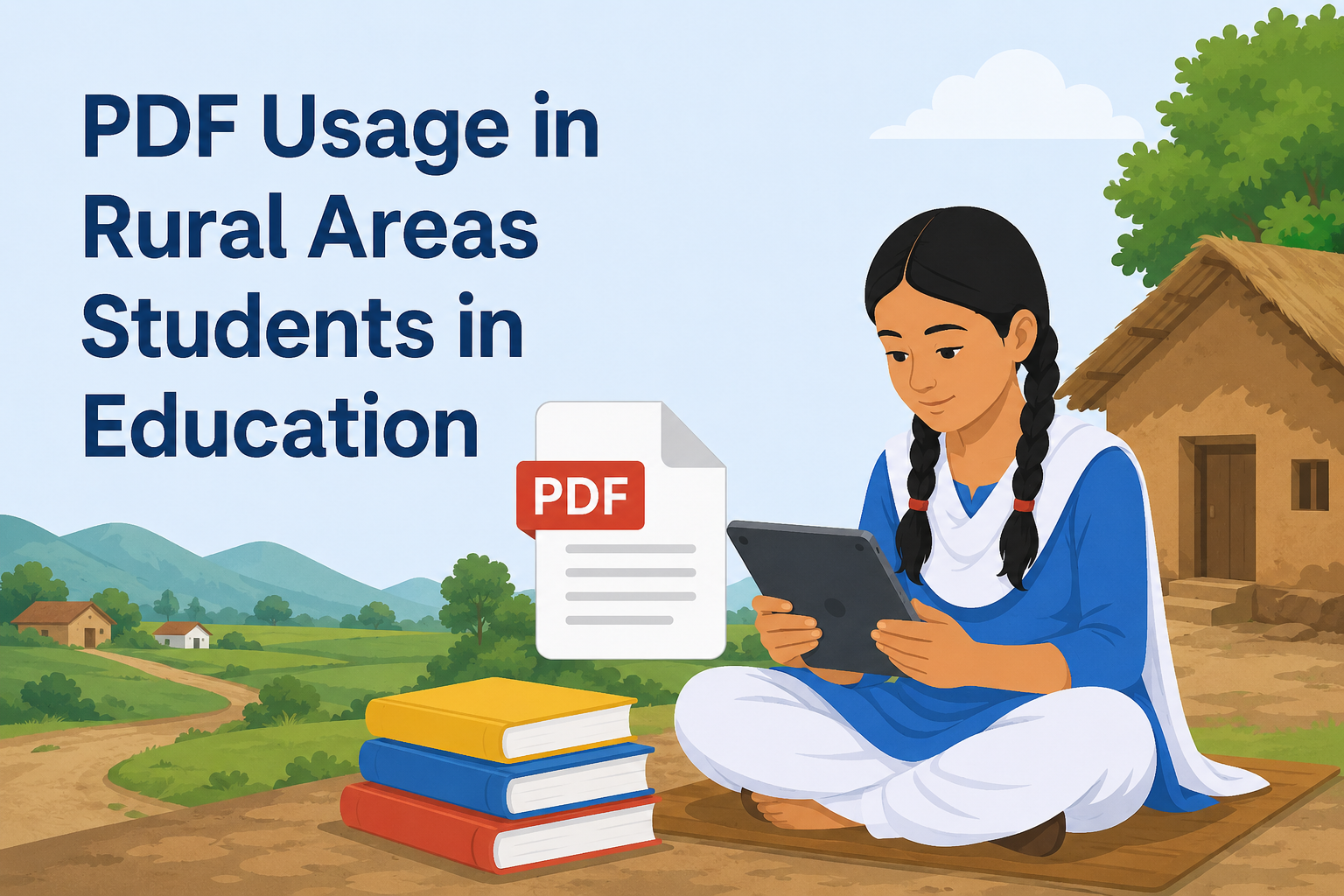
Some households share a single smartphone among multiple children.
That's where the story changes.
PDFs happen to work reasonably well across almost every device category. A student using an entry-level Android phone can usually access the same content as a student using a premium device.
The experience may not be identical.
The access often is.
That distinction matters more than many educational technology discussions acknowledge.
Equal access frequently produces greater educational impact than advanced functionality available only to a subset of learners.
## What Modern Design Trends Can Learn From PDFs
From a graphic design perspective, PDF learning materials reveal something interesting about modern content consumption.
A PDF is essentially a controlled visual environment.
I've seen beautifully designed educational layouts collapse inside poorly optimized web viewers.
Designers notice this immediately.
Students notice it when information becomes easier to understand.
## The Cost Equation Few Reports Highlight
Educational budgets are finite.
That sentence sounds obvious until funding decisions arrive.
A district choosing between producing high-quality PDF learning libraries and maintaining a complex digital ecosystem often faces difficult trade-offs.
What vendors rarely mention is the ongoing maintenance cost.
Software updates.
Technical support.
Server infrastructure.
Renewal contracts.
Compatibility testing.
The list keeps growing.
Meanwhile, a PDF created today can remain usable years later.
Not glamorous.
Extremely practical.
That's why many rural education programs continue investing in downloadable learning repositories even while experimenting with newer technologies.
They're managing risk.
## Where PDFs Fall Short
None of this means PDFs are perfect.
Far from it.
Static content has limitations.
That's not a fair comparison.
The real comparison should be between a functioning PDF-based learning program and a sophisticated platform that struggles under local infrastructure constraints.
Viewed through that lens, the conversation changes considerably.
## The Bigger Question Ahead
Rural education is not simply a technology problem.
It is an access problem.
A reliability problem.
A distribution problem.
A resource problem.
PDF learning materials continue playing a major role because they address those realities directly instead of assuming those realities have already been solved.
Will PDFs remain the dominant educational format forever? Probably not.
Yet every few years someone predicts their decline, and every few years teachers continue downloading, sharing, printing, storing, and teaching from them.
Perhaps the most revealing question isn't why PDFs are still relevant.
It's why so many educational innovations still struggle to replace something that works when everything else stops working.