How Military Organizations Use PDF Files for Secure Documentation and Operations
The argument wasn't about weapons. It wasn't about troop deployment either. The discussion that dragged on for nearly two hours revolved around a document format. One officer wanted a newer collaborative platform. Another insisted that introducing additional systems into a classified workflow would create more problems than it solved. A cybersecurity advisor sat quietly for most of the meeting before finally asking a simple question:
"What exactly is wrong with the PDF?"
The room went silent. I've seen versions of that conversation play out repeatedly across defense environments, government agencies, contractors, and security-sensitive organizations. Outsiders often assume military technology revolves around satellites, encrypted radios, drones, cyber operations, and advanced surveillance systems. Those things certainly matter. Yet behind many military decisions sits something far less glamorous. Documents. Thousands of them. Sometimes millions.
Operational plans
- maintenance logs
- engineering drawings
- intelligence briefings
- procurement records,
- compliance reports
- mission instructions
- logistics manifests
- equipment manuals
- incident investigations
- legal documentation
- training materials
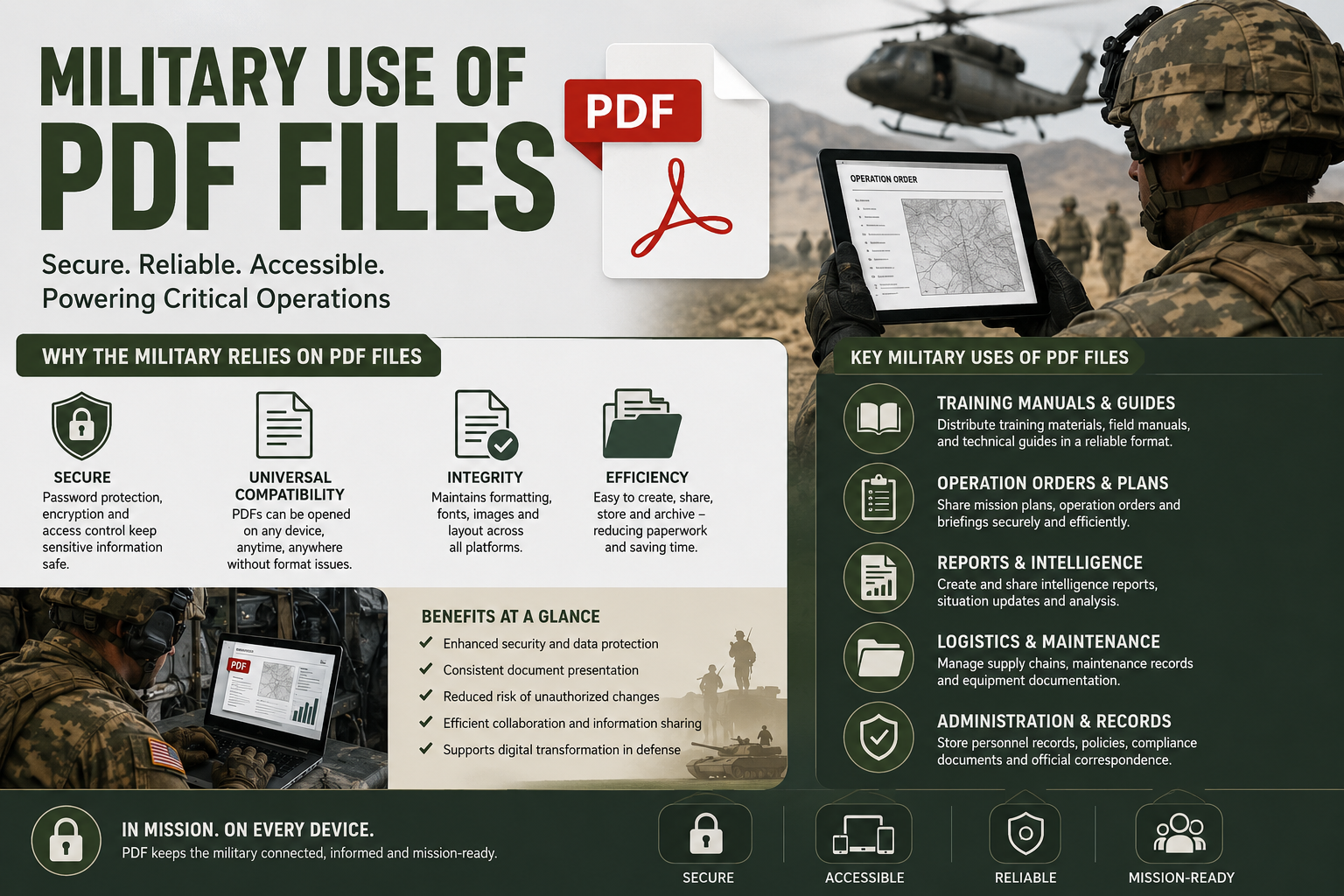
All have to move through enormous bureaucratic systems without losing integrity. That's where PDFs quietly become one of the most trusted formats in military operations.
The Military's Real Problem Isn't Creating Documents
Most people imagine military organizations spend their time generating information. The harder challenge is preserving information. There's a difference. Creating a document is easy. Keeping that document unchanged after passing through twenty departments, multiple secure networks, international coalition partners, and years of archival storage is something entirely different. I've reviewed enough enterprise documentation projects to notice a pattern. The more critical the information becomes, the less organizations care about flashy collaboration features.
They start caring about consistency.
An operations manual viewed in one location must appear exactly the same somewhere else. An aircraft maintenance checklist cannot suddenly shift formatting because somebody opened it using different software. A legal investigation report can't lose signatures because a platform update changed compatibility.
PDFs solve a very specific problem. They freeze information. That sounds boring until you imagine a maintenance technician following incorrect instructions during equipment servicing because a document rendered differently than intended. Military planners tend to think about worst-case scenarios. Document stability fits naturally into that mindset.
Security Looks Different Inside Defense Environments
Commercial users often think document security means password protection. Military organizations think much further ahead.
Who accessed the file?
When?
Where?
Was it copied?
Was it printed?
Can it be verified years later?
Those questions matter because military documentation often becomes evidence. Not courtroom evidence necessarily. Operational evidence.
Accountability evidence. Historical evidence. The uncomfortable reality is that documents sometimes outlive entire programs, leadership teams, and procurement cycles.
I've seen organizations spend millions upgrading hardware while still relying on archived PDFs created years earlier because those files represented the official record. What vendors rarely mention is that security isn't always about keeping information hidden. Sometimes it's about proving information hasn't changed. That's a completely different challenge. Digital signatures, audit trails, encryption layers, controlled distribution permissions, and archival standards all become part of the equation. Suddenly the humble PDF starts looking less like a document format and more like a compliance tool.
Why PDF Still Survives Despite New Platforms
On paper, newer systems sound reasonable. Real-time collaboration. Cloud synchronization. Live editing. Shared workspaces. Instant updates.
Then the real problem appears. Military organizations rarely operate inside a single environment.
A single mission may involve defense agencies, intelligence organizations, contractors, foreign partners, field units, logistics commands, maintenance facilities, and procurement teams. Not everyone uses the same software. Not everyone even operates on the same network. The irony is hard to ignore. The more complex the operational ecosystem becomes, the more valuable universally readable formats become. PDF doesn't require every participant to adopt identical infrastructure. That's one reason it continues surviving wave after wave of software trends.
People often mistake longevity for stagnation. They're not the same thing. Sometimes a technology survives because it solves a problem nobody has eliminated.
The Hidden Cost of Document Failure
Military professionals rarely discuss document management publicly because it sounds administrative. Administrative failures can become operational failures surprisingly fast. Consider equipment maintenance. A technician may rely on hundreds of pages of technical procedures. If a document becomes corrupted, inaccessible, or inconsistent between locations, the consequences extend beyond paperwork.
Aircraft sit grounded. Vehicles remain unavailable. Repair schedules slip. Supply chains slow down. Mission readiness drops. That's where costs start climbing. The public usually notices major defense spending programs. They rarely notice the invisible systems supporting those programs. Yet those invisible systems often determine whether expensive equipment can actually function when needed.
A fighter jet worth millions becomes significantly less useful if maintenance records become unreliable.
The Pixel Problem Nobody Notices
Most people see a PDF page. Computers see layers. Think of it like transparent sheets stacked on top of each other. One sheet contains text.
Another contains graphics. Another contains annotations. Sometimes additional layers contain signatures, metadata, security controls, or embedded references. The final page appears simple because software assembles everything into a single visual experience.
A military map displayed on one workstation should look identical on another. Tiny visual shifts can create confusion during planning, especially when coordinates, annotations, symbols, and operational references must remain precise. This issue has become more relevant as modern interface design moves toward high-fidelity visualization, immersive operational dashboards, advanced simulation environments, and layered digital mapping systems.
What sounds like a graphic design concern quickly becomes an operational concern. Most people never notice this part. Military organizations certainly do.
The Procurement Reality Nobody Advertises
Vendors love talking about innovation. Procurement officers usually care about risk. Those priorities don't always align.
A defense organization choosing a documentation system isn't simply buying software. It's making a long-term commitment that may remain active for years. That's where things become complicated. Every new platform introduces training requirements. Migration challenges. Compatibility questions. Security assessments. Certification reviews. Policy updates. Integration testing. Most executives discover this too late.
The purchase price often represents a small fraction of the total implementation cost. A stable document format like PDF reduces some of that uncertainty. Not all of it. Just enough to matter. And in highly regulated environments, reducing uncertainty often carries more value than introducing new functionality.
The Future Isn't About Replacing PDFs
People keep predicting the death of PDF. I've heard that prediction for years. It hasn't happened. That doesn't mean PDFs remain unchanged.
Far from it. Military organizations continue demanding stronger encryption models, better authentication controls, smarter metadata handling, improved document intelligence, and tighter integration with secure operational systems. The format evolves because operational requirements evolve. The larger question isn't whether military organizations will stop using PDFs.
Conclusion
The larger question is whether future security environments can maintain the same balance between accessibility, permanence, verification, and interoperability that made PDFs valuable in the first place.
Because once information becomes mission-critical, convenience stops being the primary concern.