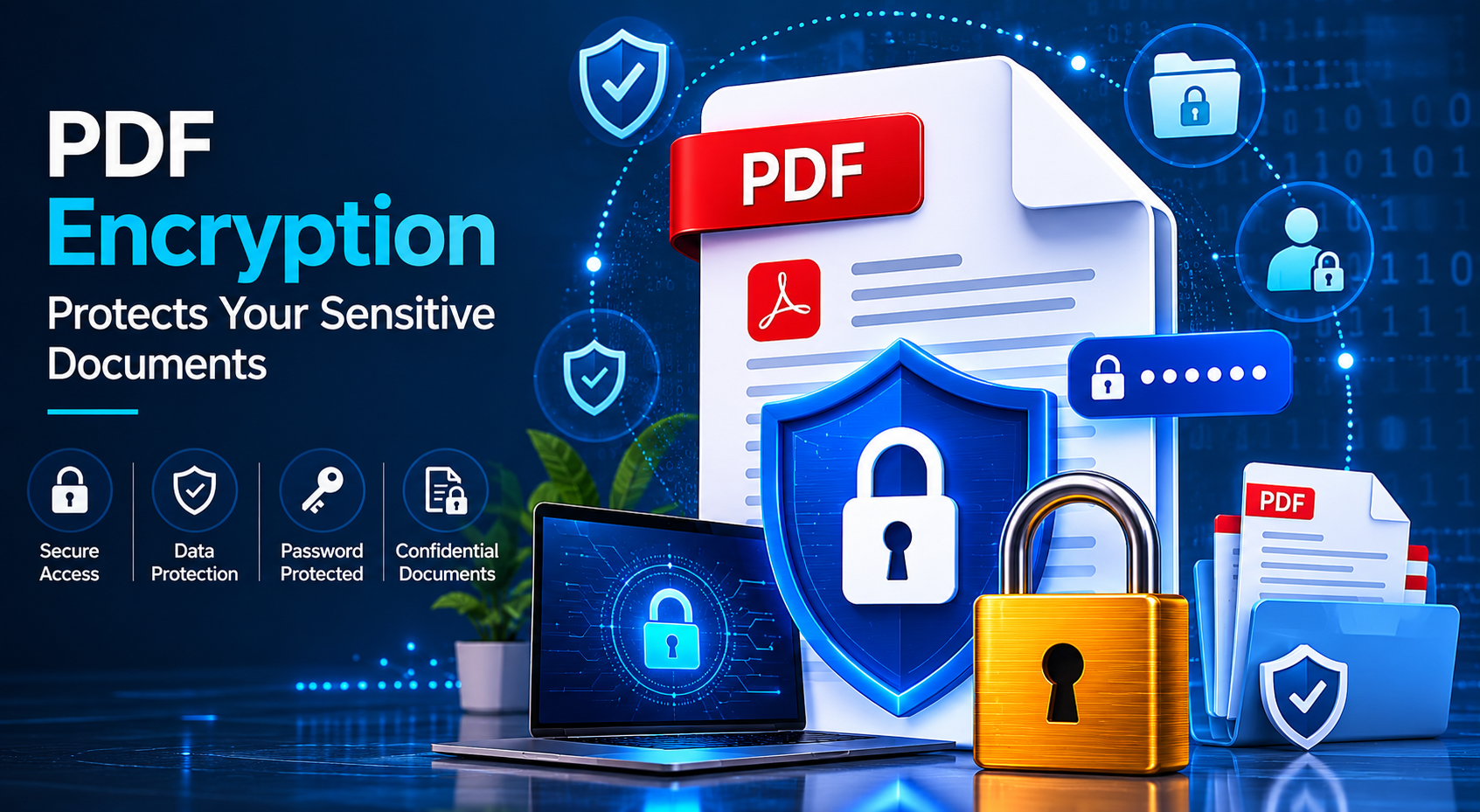
# How PDF Encryption Protects Your Sensitive Documents
The argument started because of a PDF.
Not because the document was complicated. Not because the information inside was controversial. The problem was embarrassingly simple. Somebody emailed a financial report to the wrong recipient.
Within twenty minutes, executives were on the phone. Legal teams were asking questions. IT staff were digging through email logs trying to understand what happened.
The document itself wasn't the problem.
The lack of protection was.
I've reviewed enough document management projects to notice a pattern. Most organizations spend enormous amounts of money securing networks, servers, cloud platforms, and employee devices. Then someone exports a PDF and emails it around like it's a harmless attachment.
That's usually where the story changes.
People often think PDF encryption exists for highly classified government files or confidential corporate mergers. Reality looks different. The majority of encryption use cases involve ordinary documents carrying information that becomes dangerous when viewed by the wrong person.
Employee salary reports.
Client contracts.
Medical records.
Tax documents.
Bank statements.
Engineering drawings.
Insurance claims.
Nothing dramatic. Until somebody leaks one.
The uncomfortable reality is that documents move much faster than security policies.
A company may have sophisticated access controls inside its systems, yet the moment a PDF leaves that environment, those controls often disappear. The document becomes portable. It can be copied, forwarded, downloaded, stored, and shared indefinitely.
That's exactly why PDF encryption exists.
Not to protect servers.
To protect the document itself.
## Security Doesn't Travel Automatically
One misconception appears in almost every organization I've worked with.
People assume security follows the file.
It doesn't.
Imagine locking a filing cabinet. The cabinet is secure. Then someone removes a folder from the cabinet and leaves it on a conference room table.
The cabinet remains protected.
The document doesn't.
PDF encryption solves a similar problem in digital form. Instead of protecting the storage location, encryption protects the contents of the document regardless of where it travels.
That's a subtle distinction.
It's also one of the most misunderstood aspects of document security.
What vendors rarely mention is that many breaches don't begin with hackers breaking into systems. They begin with authorized users handling documents carelessly.
A wrong email address.
A shared cloud folder.
An outdated contractor account.
A laptop left in a taxi.
None of these situations require sophisticated cybercrime.
Human beings create enough problems on their own.
## What Actually Happens Inside an Encrypted PDF?
The mechanics aren't magic.
They're mathematics.
That's essentially what encryption does at a digital level.
The interesting part is what happens after implementation.
Most people expect encryption to create inconvenience.
Sometimes it does.
Yet I've seen organizations discover that encryption actually simplifies compliance discussions because access control becomes easier to demonstrate during audits.
Compliance officers love evidence.
Encrypted PDFs provide visible evidence.
That matters more than many executives realize.
## The Hidden Problem Nobody Discusses
Here's where things become complicated.
Encryption protects information.
People don't.
I've seen encrypted documents stored alongside passwords in the same email thread.
I've seen password-protected PDFs named "Confidential_Report_Final.pdf" with the password written in the file description.
I've even seen organizations print encrypted documents and leave them unattended in public meeting rooms.
Technology can solve many problems.
Human behavior remains undefeated.
This creates an incentive nobody talks about.
Security teams often focus heavily on encryption standards while ignoring user habits. Yet user behavior frequently determines whether protection succeeds or fails.
The irony is hard to ignore.
Organizations sometimes spend months evaluating encryption technologies while spending almost no time teaching employees basic document handling practices.
## Why Modern Businesses Depend on PDF Encryption More Than Ever
Document volume has exploded.
Remote work accelerated it.
Cloud collaboration accelerated it again.
Then AI-driven workflows started generating, summarizing, analyzing, and distributing documents at a scale that few organizations anticipated five years ago.
Every new workflow creates another opportunity for sensitive information to move beyond intended boundaries.
That's not speculation.
It's operational reality.
I've watched companies implement sophisticated automation systems only to discover that sensitive PDFs were being automatically distributed to broader audiences than originally intended.
On paper, automation sounds efficient.
Reality tends to look different.
The more documents move, the more valuable document-level security becomes.
That's why PDF encryption is increasingly appearing inside legal departments, healthcare systems, financial institutions, government agencies, and engineering organizations.
Not because encryption is fashionable.
Because documents have become harder to control.
## Why Designers and Digital Product Teams Care About This Too
Many people associate PDF encryption with compliance departments.
That view is outdated.
The visible design is the exterior.
The valuable contents sit inside.
Without protection, those contents can be extracted, copied, modified, or redistributed.
This becomes especially relevant in 2026 design environments where tactile brutalism, high-fidelity interfaces, immersive product catalogs, and layered 3D commerce experiences often depend on extensive asset sharing across distributed teams.
The files themselves become business assets.
That's where costs start climbing.
One leaked design package can create far more damage than the software subscription used to create it.
## The Myth That Encryption Makes Documents Untouchable
It doesn't.
And that's an important distinction.
Encryption reduces risk.
It does not eliminate risk.
Most executives discover this too late.
Security isn't a product you purchase once.
It's a process.
An encrypted PDF can still be exposed through screenshots.
Authorized users can still intentionally share information.
Poor password management can still undermine protection.
None of this makes encryption less valuable.
It simply means security works best when combined with sensible policies, employee awareness, access controls, and practical governance.
I've seen organizations treat encryption as a silver bullet.
I've never seen that approach work for long.
## The Real Value of PDF Encryption
After years of watching document management projects succeed and fail, I've come to a simple conclusion.
The greatest value of PDF encryption isn't the technology itself.
It's the friction.
That extra moment when someone must authenticate.
That additional barrier before information changes hands.
That pause before a document becomes accessible.
Friction gets a bad reputation in technology circles. Everyone wants speed. Everyone wants convenience.
Yet when sensitive information is involved, a small amount of friction often prevents expensive mistakes.
And as documents continue moving across cloud platforms, remote teams, AI workflows, external vendors, and global supply chains, the tension between convenience and control isn't disappearing anytime soon.
If anything, the organizations that manage that tension best may discover that document security is no longer an IT problem at all. It's becoming a business survival problem.