# PDF Usage in the USA Today: Why the Format Still Dominates Digital Documents
A few years ago, I sat in on a document modernization project that had a budget large enough to make most IT managers jealous. The goal sounded simple. Replace PDFs with a more "interactive" digital document ecosystem.
Six months later, the project team was still arguing about signatures.
Not user experience. Not artificial intelligence. Not automation.
Signatures.
That's when it became obvious that many people underestimate why PDF survives every prediction of its death.
The conversation around PDFs usually focuses on technology. The reality is much less glamorous. Most organizations aren't choosing PDF because it's exciting. They're choosing it because documents break when consistency disappears.
I've reviewed enough enterprise document projects to notice a pattern. Every time someone claims they've found a better replacement, the discussion eventually circles back to one uncomfortable question.
Will the document look exactly the same everywhere?
That's where the story changes.
## The Real Value Was Never the File Format
Most people think PDF succeeded because it preserved text and images.
That's only part of the story.
The real breakthrough was trust.
When a mortgage application leaves a bank in Texas and arrives at a law office in New York, nobody wants surprises. The recipient shouldn't see a different font. A paragraph shouldn't move to the next page. A signature block shouldn't suddenly shift position because somebody opened the file on another device.
Sounds obvious.
Yet entire industries depend on that certainty.
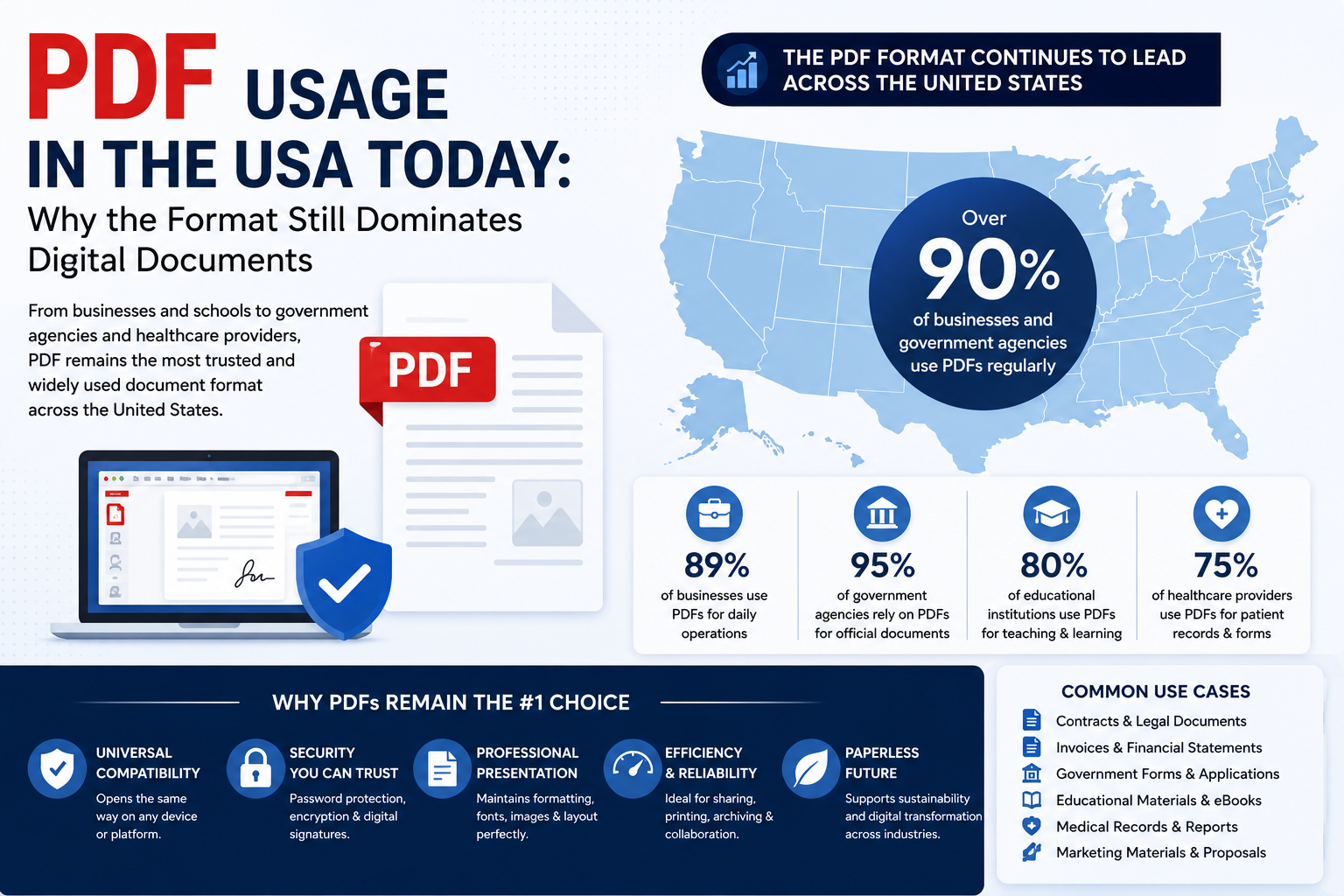
Healthcare providers exchange patient records. Courts exchange legal filings. Insurance companies process claims worth millions of dollars. Government agencies archive documents that may be referenced years later.
What vendors rarely mention is that most document problems aren't caused by missing features. They're caused by inconsistency.
PDF solved consistency decades ago.
Many alternatives still struggle with it.
## Government Systems Quietly Depend on PDF
People love criticizing government websites.
Sometimes fairly.
Still, there's a reason PDFs remain everywhere across federal, state, and local agencies.
Imagine a benefits application viewed on twenty different devices, printed by multiple departments, archived for ten years, then reviewed during an audit.
That's not a design problem.
That's a risk management problem.
Most executives discover this too late.
A flashy web form may improve the front-end experience. The moment records must be preserved, validated, printed, shared, legally referenced, and stored, PDF often reappears behind the scenes.
The irony is hard to ignore.
Many "paperless transformation" projects eventually produce more PDFs than the systems they replaced.
## Businesses Care About Liability More Than Innovation
Technology conferences often create the impression that organizations are aggressively pursuing the newest document formats.
Reality tends to look different.
Corporate legal departments rarely wake up asking for innovation.
They ask for defensibility.
Can this document be preserved?
Can it be reproduced?
Can it be verified?
Can it survive litigation?
Those questions shape purchasing decisions far more than most software demonstrations.
I've watched procurement teams reject technically impressive platforms because document retention policies became complicated. The software wasn't necessarily bad.
The compliance risk looked expensive.
That's enough to kill many projects.
## The Hidden Economics Nobody Talks About
A surprising number of PDF discussions ignore economics.
That's a mistake.
Every organization already knows how PDFs behave. Employees understand them. Customers recognize them. Printers handle them. Auditors accept them.
Replacing that familiarity carries a cost.
Training costs.
Migration costs.
Support costs.
Integration costs.
Then the real problem appears.
Unexpected costs.
A document format may look cheaper during a sales presentation. Once legacy systems, archives, workflows, approvals, and external partners enter the equation, budgets start swelling in ways project planners rarely predict.
What looks simple on paper often becomes expensive in practice.
I've seen organizations spend millions modernizing document workflows only to preserve PDF as the final output.
That tells you something.
## Why Consumers Keep Choosing PDFs
Corporate behavior explains part of the story.
Consumer behavior explains the rest.
Think about job applications.
Tax forms.
Apartment leases.
School admissions.
Medical paperwork.
People don't consciously choose PDF because they love the format.
They choose it because they trust what will happen after clicking download.
The file opens.
The layout remains intact.
The document prints correctly.
That's it.
Sometimes the most successful technology isn't the one people admire.
It's the one they stop thinking about.
PDF reached that stage years ago.
## AI Hasn't Changed the Core Problem
Artificial intelligence dominates technology headlines.
Document management vendors know this.
Every conference seems filled with promises about intelligent workflows, automated extraction, semantic search, and AI-driven document experiences.
Some of those capabilities are genuinely useful.
Others feel suspiciously close to marketing theater.
Here's what I keep noticing.
Even when AI systems analyze documents, summarize documents, classify documents, or extract information from documents, the underlying file frequently remains a PDF.
That's because AI changes how information is processed.
It doesn't automatically change how organizations need information preserved.
Those are different problems.
And they're often confused.
## The Design World Still Relies on PDF More Than It Admits
From a design perspective, PDF occupies a strange position.
Designers constantly experiment with new visual systems. Interactive layouts continue evolving. Three-dimensional commerce experiences are becoming increasingly common. Raw, intentionally imperfect interfaces are appearing across modern web design.
Yet PDF remains deeply embedded in professional workflows.
Think about a printed catalog created for a luxury retailer.
Imagine pixels as tiles permanently fixed into a floor pattern.
Move the floor into another building and the arrangement remains unchanged.
That's essentially what PDF attempts to do with document presentation.
The concept sounds simple.
The engineering challenge isn't.
Anti-aliasing, font embedding, transparency layers, image compression, and rendering instructions all work together to ensure the final appearance remains stable. Most users never notice those mechanics. They only notice when something goes wrong.
And when a document worth millions of dollars is involved, "going wrong" becomes a very expensive phrase.
## The Future Nobody Wants to Predict
Every few years, someone declares PDF obsolete.
I've lost count.
The prediction usually comes from a company selling something designed to replace it.
That doesn't automatically make the prediction wrong.
Technology does evolve.
User expectations evolve.
Workflows evolve.
Still, there's a stubborn reality sitting underneath every discussion.
Documents exist because people need evidence.
Evidence of agreements.
Evidence of transactions.
Evidence of approvals.
Evidence of accountability.
As long as organizations continue valuing stable, portable, legally defensible records, PDF remains attached to a problem that hasn't disappeared.
The question isn't whether newer technologies can create better document experiences.
The harder question is whether any replacement can deliver the same level of trust while navigating compliance requirements, legal scrutiny, archival obligations, procurement realities, and decades of institutional habits without creating entirely new risks nobody has discovered yet.