Why PDF Watermarks Matter: Protecting Documents in a Digital World
A project manager had emailed a proposal to a prospective client. A few weeks later, almost the same document appeared in the hands of a competitor. Pricing details were identical. Layouts matched. Internal notes had somehow survived the journey. Nobody could immediately determine who shared it. The document itself wasn't encrypted. It wasn't locked down. It wasn't protected by sophisticated security software. It was simply a PDF.
I've seen situations like this more times than most people would expect. Companies spend heavily on cybersecurity, endpoint protection, access management, and compliance audits. Then they distribute sensitive documents without leaving any trace of ownership inside them. That's where watermarks enter the conversation.
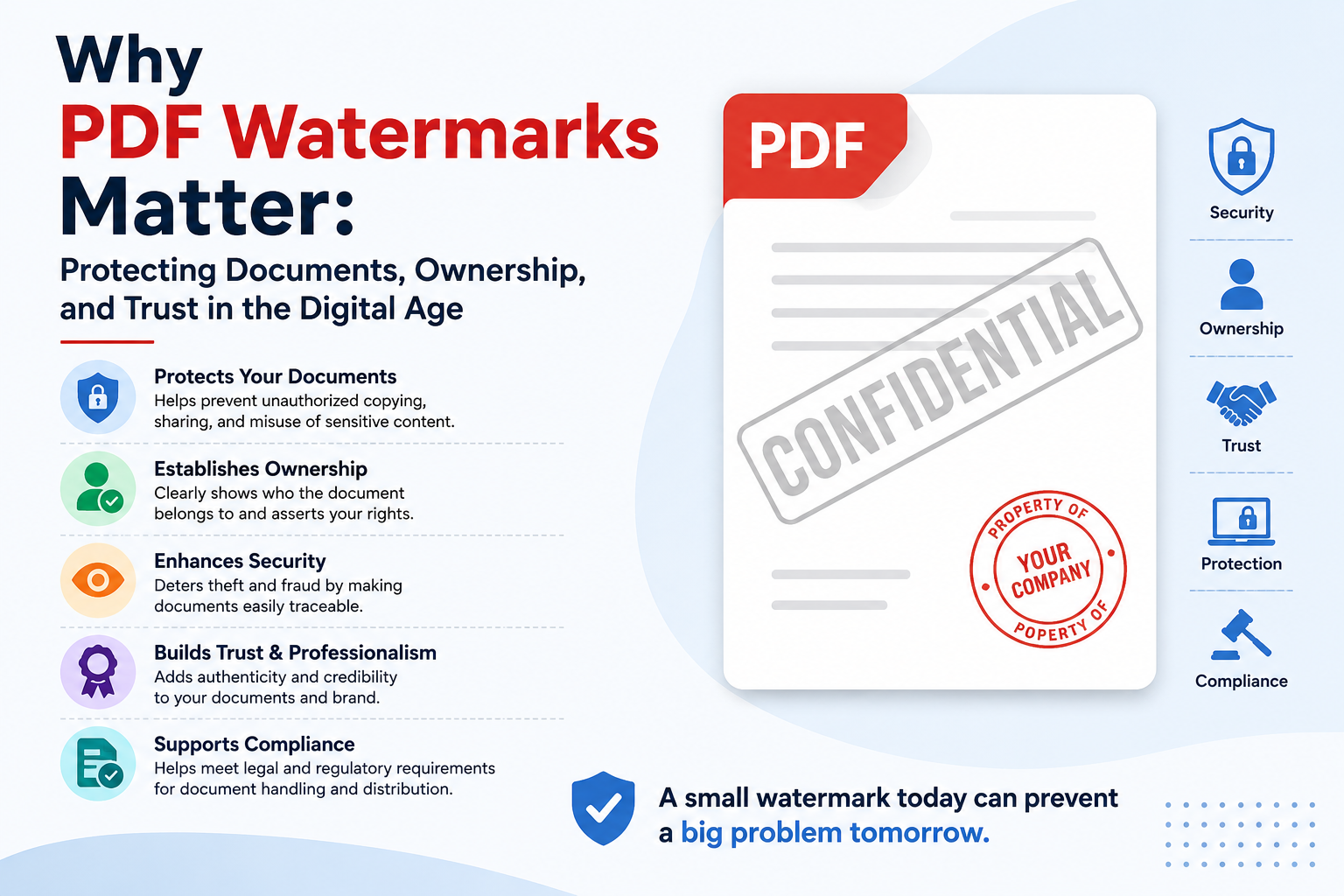
Most people think of PDF watermarks as a visual nuisance. A faint logo in the background. A diagonal "CONFIDENTIAL" stamp across a page. Something that makes a document look official. Reality is more interesting. A watermark often changes behavior before it prevents theft.
That distinction matters. When employees receive a document displaying their name, email address, department, or distribution ID directly on every page, they suddenly become aware that the file is traceable. The document becomes personal. Sharing it feels different.
Human psychology frequently succeeds where technology struggles
I've reviewed enough document management projects to notice a pattern. Organizations often focus on preventing unauthorized access while paying far less attention to discouraging irresponsible sharing after access has already been granted. Those are very different problems. A document can be perfectly secure inside a storage platform. The moment someone downloads it, emails it, prints it, screenshots it, or uploads it elsewhere, the security model changes completely. That's where things become complicated. Many executives assume document protection is primarily a technical challenge. On paper, that sounds reasonable. Reality tends to look different.
Most document leaks don't begin with elite hackers
They begin with ordinary people. Someone forwards an attachment.
- Someone uses a personal email account
- Someone saves a copy onto an unmanaged device
- Someone sends the wrong version to the wrong recipient
A watermark doesn't stop every mistake. What it does is create accountability. And accountability changes behavior.
Legal teams understand this well
When contracts, financial reports, merger documents, intellectual property records, engineering drawings, or compliance materials circulate between multiple parties, questions eventually arise. Who received the document? Which version was distributed? Where did the leaked copy originate?
Without a watermark, answers become difficult. With a properly implemented watermark strategy, investigations often become significantly easier. What vendors rarely mention is that watermarks aren't really about decoration. They're evidence.
The difference sounds subtle until an organization faces an actual dispute.
1. Documents travel
2. People share them
3. Control weakens with every transfer
The irony is hard to ignore. Digital transformation was supposed to reduce paper dependency. Instead, organizations now distribute far more documents than they did fifteen years ago. Files move faster. Distribution lists grow larger. Collaboration spans multiple organizations, vendors, consultants, and external stakeholders.
The attack surface expands accordingly. I've watched organizations spend months implementing sophisticated document workflows only to discover that downloaded PDFs remain the weakest link in the entire process. Nobody talks about that during software demonstrations. Those meetings usually focus on features.
The operational reality arrives later. A watermark works somewhat like writing your name inside a borrowed book. The book still exists. The pages still function normally. Nothing physically prevents someone from taking it elsewhere. Yet ownership remains visible. That simple visibility often changes decisions. Modern document ecosystems have made watermarks even more relevant.
Raw web interfaces, collaborative review systems, cloud storage platforms, and distributed work environments have dramatically increased the number of document touchpoints. A single PDF may pass through dozens of hands before reaching its final destination.
Every transfer introduces uncertainty. Every download creates another copy.Every copy creates another opportunity for misuse. Most users never notice how quickly duplication occurs. A document attached to one email becomes five copies. A team download creates ten more. A local backup creates another version. A screenshot becomes a completely separate asset. The multiplication happens quietly.
Then the real problem appears. Nobody knows which copy escaped. Organizations often discover this too late. One executive recently described a leaked financial presentation as "appearing everywhere at once." That's usually how these situations feel. By the time someone notices the leak, the original source has already disappeared beneath layers of redistribution. Watermarks don't eliminate that risk.
They narrow the search. And sometimes that's enough. There's another reason watermarks matter that rarely appears in marketing brochures. Perception. Clients, partners, regulators, auditors, and stakeholders often interpret visible document controls as evidence of professionalism. A clearly marked confidential document communicates expectations before anyone reads the first paragraph.
That may sound cosmetic. It isn't. People respond to signals. A watermark quietly communicates that somebody cares about document governance. That message carries weight. Of course, watermarks aren't perfect. Nothing is.
Sophisticated users can sometimes crop them. Screenshots can remove portions. Certain editing tools can reduce visibility. Determined actors occasionally find ways around almost any protection mechanism. Some critics point to these limitations and dismiss watermarks entirely. I think that's a mistake. Security has never been about creating impossible barriers. It's about reducing risk.
Conclusion
The uncomfortable reality is that most organizations don't lose information because protections failed. They lose information because protections never existed in the first place. That's a very different conversation. When people ask whether PDF watermarks still matter in 2026, I usually answer with another question. As documents continue moving faster, across more systems, between more organizations, and through increasingly decentralized work environments, what mechanism will remind people that information still belongs to someone?
The industry hasn't produced a better answer yet.